


Page 122 - AERB Annual Report 2020
P. 122
7.4.6 Synthesis and Characterization of has much attention due to their high chemical
Neodymium and Uranium loaded durability as well as mechanical stability. Such
Strontium Borophosphate (SBP) Glasses materials are nding applications in vitrication
for Waste Immobilization applications of radioactive waste and glass to metal seals of
biomaterials. Strontium borophosphate (SBP)
Various material types have been glasses were synthesized by adding lithium as a
considered as candidates for immobilization of ux and zinc as a modier. Neodymium and
specic radioactive wastes such as glass, uranium are doped in SBP to study the solubility
ceramics, cement, bitumen and metals. Glass is and thermal stability. The formation of SBP glass
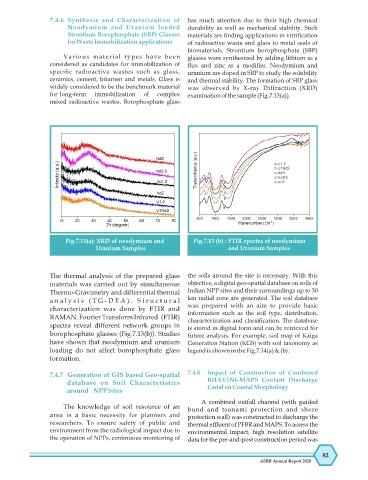
widely considered to be the benchmark material was observed by X-ray Diffraction (XRD)
for long-term immobilization of complex examination of the sample (Fig.7.13(a)).
mixed radioactive wastes. Borophosphate glass
Fig.7.13(a): XRD of neodymium and Fig.7.13 (b) : FTIR spectra of neodymium
Uranium Samples and Uranium Samples
The thermal analysis of the prepared glass the soils around the site is necessary. With this
materials was carried out by simultaneous objective, a digital geo-spatial database on soils of
Thermo-Gravimetry and differential thermal Indian NPP sites and their surroundings up to 30
km radial zone are generated. The soil database
a n a l y s i s ( T G - D T A ) . S t r u c t u r a l
was prepared with an aim to provide basic
characterization was done by FTIR and
information such as the soil type, distribution,
RAMAN. Fourier Transform Infrared (FTIR)
characterization and classication. The database
spectra reveal different network groups in is stored in digital form and can be retrieved for
borophosphate glasses (Fig.7.13(b)). Studies future analysis. For example, soil map of Kaiga
have shown that neodymium and uranium Generation Station (KGS) with soil taxonomy as
loading do not affect borophosphate glass legend is shown in the Fig.7.14(a) & (b).
formation.
7.4.7 Generation of GIS based Geo-spatial 7.4.8 Impact of Construction of Combined
BHAVINI-MAPS Coolant Discharge
database on Soil Characteristics
Canal on Coastal Morphology
around NPP Sites
A combined outfall channel (with guided
The knowledge of soil resource of an
bund and tsunami protection and shore
area is a basic necessity for planners and protection wall) was constructed to discharge the
researchers. To ensure safety of public and thermal efuent of PFBR and MAPS. To assess the
environment from the radiological impact due to environmental impact, high resolution satellite
the operation of NPPs, continuous monitoring of data for the pre-and-post construction period was
82
AERB Annual Report 2020

