


Page 125 - AERB Annual Report 2020
P. 125
7.6.3 Water and Steam Interaction Facility 7.6.4 AGMS and Coolant Channel Heat-up
(WASIF) Facility
The Water and Steam Interaction Facility An experimental facility has been set-up at
(WASIF) Phase-1 has been commissioned within SRI, Kalpakkam for investigating coolant channel
the high bay of the SRI Engineering hall at heat-up and annulus gas monitoring system
Kalpakkam to investigate Condensation Induced related safety issues. There are nine PT-CT
Water Hammer (CIWH) phenomena. It has been assemblies and each is provided with tubular
set up in collaboration with BARC. As part of heater of 3.6 kW. The heating rate varies linearly
commissioning of the facility, several activities from one end to the other, so as that the PT inner
were undertaken such as performance test of surface temperature varies from around 250 to
steam boiler in stand-alone mode, preparation of 300 °C. The direction of heating is reversed in
test matrix, experimental procedure, safety alternate channels. Thermocouples have been
precautions to be taken etc. Sixteen CIWH installed to measure temperatures at PT inner
experiments were conducted using test pipe sizes surface, CT outer surface, annulus gas region etc.
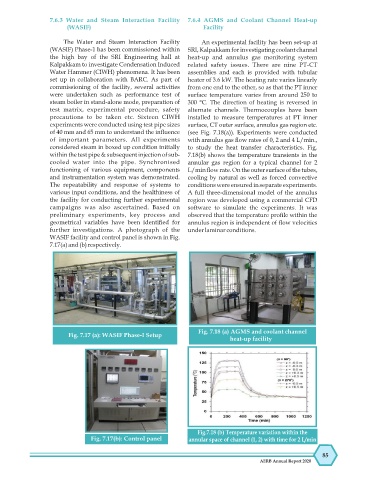
of 40 mm and 65 mm to understand the inuence (see Fig. 7.18(a)). Experiments were conducted
of important parameters. All experiments with annulus gas ow rates of 0, 2 and 4 L/min.,
considered steam in boxed up condition initially to study the heat transfer characteristics. Fig.
within the test pipe & subsequent injection of sub- 7.18(b) shows the temperature transients in the
cooled water into the pipe. Synchronised annular gas region for a typical channel for 2
functioning of various equipment, components L/min ow rate. On the outer surface of the tubes,
and instrumentation system was demonstrated. cooling by natural as well as forced convective
The repeatability and response of systems to conditions were ensured in separate experiments.
various input conditions, and the healthiness of A full three-dimensional model of the annulus
the facility for conducting further experimental region was developed using a commercial CFD
campaigns was also ascertained. Based on software to simulate the experiments. It was
preliminary experiments, key process and observed that the temperature prole within the
geometrical variables have been identied for annulus region is independent of ow velocities
further investigations. A photograph of the under laminar conditions.
WASIF facility and control panel is shown in Fig.
7.17(a) and (b) respectively.
Fig. 7.18 (a) AGMS and coolant channel
Fig. 7.17 (a): WASIF Phase-I Setup
heat-up facility
Fig.7.18 (b) Temperature variation within the
Fig. 7.17(b): Control panel annular space of channel (1, 2) with time for 2 L/min
85
AERB Annual Report 2020

