


Page 124 - AERB Annual Report 2020
P. 124
beginning. In this study, typical refuelling heat ux to study the in-vessel retention
shutdown plan of TAPS-2 has been used to derive capability of calandria vessel. For sub-cooled pool
the plant operating states. The results of the boiling without any obstructions, test vessel was
shutdown PSA indicate that a high level of able to dissipate the heat into the vault water up to
defence-in depth exists in TAPS-1&2 design a heat ux of 270 kW/m2. However, for sub-
during shutdown mode of operation. This is cooled pool boiling with obstructions at outer
evident from the nal CDF value, as well as from surface like calandria outlet pipes, lower heat
the predominantly higher order minimal cut-sets removal was observed.
(MCS) observed in the core damage sequences. It
was observed that no human action is dominating Numerical studies were also carried out to
in top 100 minimal cut-sets. Station has understand the effect of calandria vault water
incorporated several hook-up points to inject temperature in the presence of ow obstructions.
water as a part of post Fukushima modications. Based on these studies, a correlation has emerged
However, the credit for the above hook-ups, were between the Critical Heat Flux (CHF) value and
not considered in the present study to have a the degree of sub-cooling of the bulk boiling
condence that the existing design will comply liquid.
with the general safety objectives. Moreover,
considering the hook-ups in the analysis will 7.6.2 Performance of Fire-Retardant Paint on
mask the plant possible vulnerabilities, important Cables
human actions and system weaknesses. Taking
the credit of these hook-ups, the CDF value will As part of conrmatory research and
reduce substantially. competence development, experimental studies
in the eld of cable res were continued in
7.6 EXPERIMENTAL STUDIES Compartment Fire Test Facility (CFTF) at SRI,
Kalpakkam. Fire performance of cables coated
7.6.1 In-vessel Retention of Corium in with different thicknesses of intumescent paint
Calandria Vessel of PHWRs was investigated. Test samples were prepared
and experiments were carried out based on
The COre Melt REtention Facility available standards for cable tests (IEC 60332-3),
(COMREF) is established in SRI Engineering hall with some modications. Cable samples were
at Kalpakkam, to investigate the in-vessel prepared using aged cables and also using fresh
retention capability of calandria vessel during cables used for power, control and signal
postulated severe accident conditions. The decay transmission. Parameters such as electrical
heat ux due to corium on the calandria vessel continuity after re exposure, spontaneous
inner surface is simulated using an induction ignition, swelling, decomposition, ame
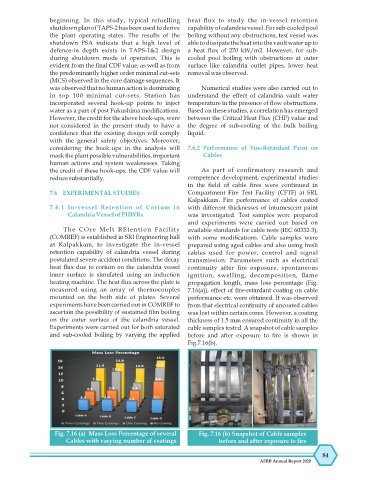
heating machine. The heat ux across the plate is propagation length, mass loss percentage (Fig.
measured using an array of thermocouples 7.16(a)), effect of re-retardant coating on cable
mounted on the both side of plates. Several performance etc. were obtained. It was observed
experiments have been carried out in COMREF to from that electrical continuity of uncoated cables
ascertain the possibility of sustained lm boiling was lost within certain cores. However, a coating
on the outer surface of the calandria vessel. thickness of 1.5 mm ensured continuity in all the
Experiments were carried out for both saturated cable samples tested. A snapshot of cable samples
and sub-cooled boiling by varying the applied before and after exposure to re is shown in
Fig.7.16(b).
Fig. 7.16 (a) Mass Loss Percentage of several Fig. 7.16 (b) Snapshot of Cable samples
Cables with varying number of coatings before and after exposure to re
84
AERB Annual Report 2020

